A Philatelic Glossary - Stamp Collecting Terms & Abbreviations
Stamp Collecting and philately, like many other specialised fields, have their own unique terminology and vocabulary. This glossary is my attempt
to demystify much of the jargon for beginners that seasoned collectors may take for granted.
Hopefully, this glossary will also be of help to the more experienced philatelist, providing a convenient reference when faced with unfamiliar terms.
NOTE: This glossary is regularly being added to and updated.
Index
| A . B . C . D . E . F . G . H . I . J . K . L . M . N . O . P . Q . R . S . T . U . V . W . X . Y . Z |
A
B . C . D . E . F . G . H . I . J . K . L . M . N . O . P . Q . R . S . T . U . V . W . X . Y . Z| Admiral | The Admirals, an informal but widely used name for four definitive series of the British Commonwealth depicting King George V in naval uniform:
|  |
| Aerogramme, Aerogram | An aerogramme is a lightweight, postage-prepaid airmail lettersheet designed to be folded and sealed to form its own envelope. Enclosures, such as photographs or extra paper, are not permitted as aerogrammes are usually carried at a lower rate than regular airmail. The Universal Postal Union officially designated these as aerogrammes in 1952, prior to which they were known as Air Letter Sheets or Air Mail Letter Cards.  |  |
| Aerophilately | Aerophilately is the branch of philately that focuses on the study and collection of mail transported by air, including airmail stamps, airmail etiquettes, first flight covers, postal stationery, and crash covers, as well as the specific journey the mail took. Aerophilately is not restricted to items flown only on fixed-wing aircraft but includes items flown on all forms of air transport, including planes, helicopters, balloons, and rockets. For example, the cover illustrated here was carried aboard the Graf Zeppelin airship in 1930 (image sourced from Wikipedia). |  |
| Airmail | Airmail, mail transported by air, has been the standard method for conveying international mail since the 1970s. However, prior to that, airmail was a premium service requiring a supplemental fee. Items intended to be carried by airmail are generally identified using a blue and white airmail label, known as an etiquette, or by utilising an airmail envelope with its distinctive blue and red striped border, often pre-printed with an airmail label. |  |
| Airmail stamp | Airmail stamps are postage stamps issued by many countries specifically designated for use on airmail. The world's first airmail stamp was issued by Italy in May 1917 for an experimental airmail service between Turin and Rome. This was created by overprinting an existing 25 centesimo Special Delivery stamp with the text: "ESPERIMENTO POSTA AEREA, MAGGIO 1917, TORINO-ROMA - ROMA-TORINO" (Airmail Experiment May 1917 Turin-Rome - Rome-Turin). While many nations continued to issue specific airmail stamps for decades, modern postal services now generally allow standard postage stamps to be used for all methods of transport. |  |
| Albino | An albino is a colourless impression of a stamp design, typically resulting from an uninked printing plate being applied to the paper. It often occurs when two or more sheets are accidentally fed into the printing press simultaneously; the top sheet receives the ink, while the underlying sheet receives only the physical impression of the die. | |
| Album Weed | Album weeds, a collective term for fakes, forgeries, and other similar items that appear to be genuine postage stamps but are not. The term was likely popularised by the seminal work "Album Weeds or How to Detect Forged Stamps" by the Reverend R. B. Earée, first published in 1882. The third and final edition, published in 1906, remains the classic work on the subject. |  |
| Ambulance Cover | Protective official envelopes used by postal authorities to enclose and deliver mail severely damaged in transit are informally known as "Ambulance Covers" or, particularly in the US, regarding modern plastic sleeves, "Body Bags". These covers are typically marked with a cachet or label explaining the damage. While often associated with Crash Covers and Wreck Mail, they are also used for items damaged by sorting machinery or during conveyance through the post. |  |
| American Philatelic Research Library (APRL) | The American Philatelic Research Library was incorporated in 1968 as the research and educational arm of the American Philatelic Society. Located in Bellefonte, Pennsylvania, it houses one of the world's largest and most significant collections of philatelic literature, containing over 23,000 book titles and 5,700 journal titles. It provides research services and digital archives to collectors worldwide. | |
| American Philatelic Society (APS) | Founded in 1886, the American Philatelic Society is the largest non-profit organisation for stamp collectors in the world, with a membership spanning more than 110 countries. The Society provides a wide variety of programmes and services, including expertising, estate advice, and the publication of The American Philatelist, its monthly journal. It serves as the primary representative body for the hobby in the United States and also operates the American Philatelic Research Library. | |
| American Stamp Dealers Association (ASDA), | The American Stamp Dealers Association, founded in 1914, is an organisation of professional stamp dealers dedicated to promoting integrity, honesty, and reliability within the hobby. Members must follow a strict code of ethics, providing collectors with a level of security when buying or selling material. | |
| ATM | See: Machine Label | |
| Aniline Ink | Aniline Ink is a fugitive, coal-tar-based, water-soluble ink that is known to bleed or run when moistened. It was primarily used to discourage the illegal reuse of previously cancelled stamps by ensuring that any attempt to soak the stamp from an envelope, or remove the cancellation, would cause the stamp's colour to bleed or fade, visibly damaging it. Collectors should take great care when handling stamps printed with aniline ink, as even brief immersion in water can permanently ruin the design. | |
| APRL | See: American Philatelic Research Library | |
| Approval Book | An approval book is a booklet containing pre-priced stamps that a dealer sends to a customer for them to choose from. Under this system, the customer chooses the stamps they wish to purchase and returns the booklet to the dealer within a specified timeframe, typically 10 to 14 days, along with payment for the items kept. See also: Circuit Book. | 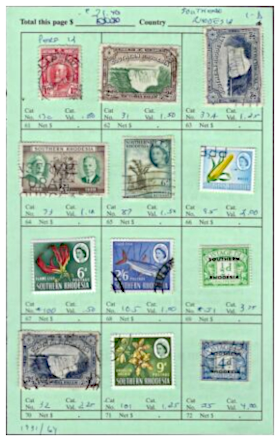 |
| APS | See: American Philatelic Society | |
| Army Telegraphs | See: Telegraph stamps | |
| Arricator | See: Arrow indicator | |
| Arrival Mark | See: Receiving Mark | |
| Arrow block, Arrow | Arrow blocks are blocks of four or more stamps with attached selvedge containing an arrow-like marking. These markings are placed in the sheet margins by the printer to serve as guides for registration and alignment, or as indicators of where a sheet should be perforated or cut into smaller panes. | 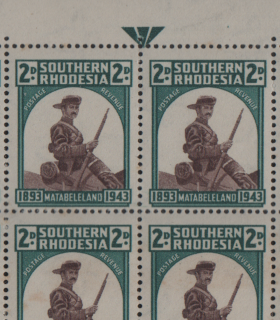 |
| Arrow indicator | Also known as an arricator, an arrow indicator is a small, typically self-adhesive arrow used by collectors to highlight errors, varieties, or specific items of interest on philatelic material. High-quality indicators are designed with "low-tack" adhesive to ensure they can be removed without damaging or staining the item. | 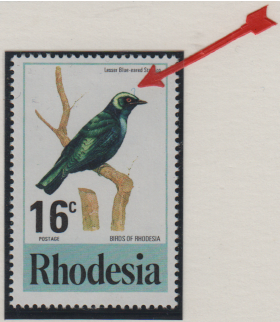 |
| ASDA | See: American Stamp Dealers Association | |
| ASFE, ASFEC | ASFEC (A Stamp From Every Country) is a worldwide collection consisting of a single postage stamp from every stamp-issuing postal entity throughout history. This includes not only present-day sovereign states, but also former states, colonies, protectorates, military occupations, short-lived provisional governments, and other postal administrations that have issued postage stamps.ASFE (A Stamp From Everywhere) extends the ASFEC concept beyond postage stamps to encompass all types of adhesive stamps issued by all stamp-issuing entities. In addition to postage stamps, this may include, amongst others, revenue stamps, local post stamps, railway stamps, telegraph stamps, and other specialist stamp issues. |  |
| Authentication mark | See: Expertising mark |
B
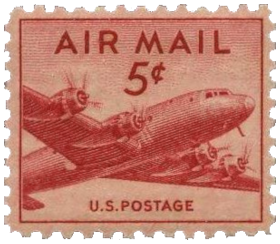
A . C . D . E . F . G . H . I . J . K . L . M . N . O . P . Q . R . S . T . U . V . W . X . Y . Z| Back Of Book (BOB) | Back of the Book refers to the editorial practice, followed by some catalogue publishers, of removing certain categories of valid postage stamps, most notably Airmails and Charity stamps (Semipostals), from their chronological place in the main listings and relegating them to a section at the "back of the book". Not all collectors are in favour of this practice on the grounds that it is:
|  |
| Backprint | A backprint is any text or design that is intentionally printed on the reverse of a stamp. For example, the advertising slogans found on the backs of some New Zealand stamps from the 1890s. Backprints are sometimes erroneously referred to as underprints. | 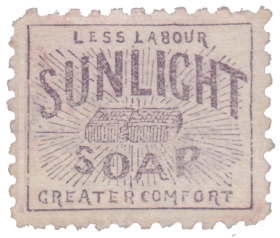 |
| Backstamp | Backstamps are postmarks, such as receiving or transit marks, applied to the reverse side of a postal item. Unlike the primary cancellation on the front, which defaces the stamp, these ancillary markings are applied to the reverse to avoid obscuring the address. As an item moves through the postal system, backstamps record key points along the route, such as arrival at a sorting office and final delivery, making them an invaluable tool for the postal historian. | 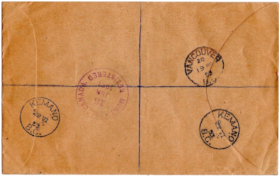 |
| Bantam | An informal name for the reduced-size stamps of the 1942-1944 Union of South Africa Wartime definitive series. This format was chosen as part of the War Effort to conserve paper. The term is also used more generally to refer to other smaller-than-normal stamps, such as the 1870 Queen Victoria British halfpenny stamp. |  |
| Bilingual | A bilingual stamp is one that features inscriptions in two different languages. This is common in countries with more than one official language, such as Canada, South Africa, or Belgium. A bilingual pair is a se-tenant pair of stamps, with each stamp inscribed in an alternate language. For example, many stamps of the Union of South Africa were printed alternately in English and Afrikaans. In such cases, the stamps are best collected in pairs. |  |
| Bilingual pair | See: Bilingual | |
| Bisect | A bisect is a stamp cut in two, each half representing half the face value of the original stamp, as a way to address a temporary shortage of a particular denomination. For example, in 1900, due to a shortage of 5pf stamps, the Keetmanshoop Post Office in German South West Africa issued bisected 10pf stamps in their place. Bisects are best collected tied to piece; otherwise, authenticity is difficult, if not impossible, to confirm. | 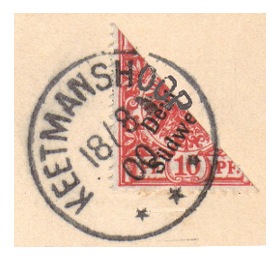 |
| Bishop mark | The Bishop Mark, introduced in 1661 by Henry Bishop, is widely considered the first standardised postmark. It consisted of a small circular handstamp divided by a horizontal line, with the day of the month on one side and a two-letter abbreviation for the month on the other. Its purpose was to record when a letter arrived at the post office, helping to ensure that it was processed and dispatched without unnecessary delay. | 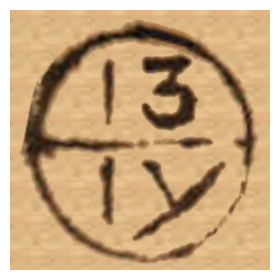 |
| Blackprint, Black Print | Blackprints are commemorative items, often issued as imperforate miniature sheets. Produced specifically for the collector market and generally not valid for postal use, they are frequently printed in limited quantities and often individually numbered to increase their appeal to collectors. And even when produced in colour, they are still referred to as blackprints. |  |
| Blind perforation | Blind perforations occur when the perforating device has not fully pierced the paper, leaving a faint impression instead of a clear hole. |  |
| BOB | See: Back Of Book | |
| Booklet | A stamp booklet is a small booklet containing one or more panes of postage stamps, bound between thin card covers. The covers and any interleaving pages often include advertising or other informational text. Some collectors separate booklets into individual panes or pages for display in an album. An unexploded booklet is one that remains intact as issued, complete with its original staples or binding. |  |
| Bourse | Bourse (French for 'stock exchange') is a gathering of dealers and collectors where stamps and other philatelic items are bought and sold. While a bourse often takes place alongside a philatelic exhibition, the term specifically refers to the commercial area where trading occurs. |  |
| Bullseye cancellation | See: Socked-on-the-nose | |
| Burelage | Burelage (from the French), also known as burelé, is a fine, net-like pattern of coloured lines or dots printed on the stamp paper to discourage forgeries. Depending on the issue, burelage may be applied to the face of the stamp as an underprint or to the reverse as a backprint. | 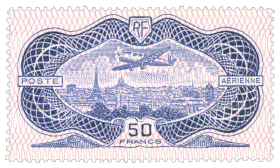 |
| Burelé | See: Burelage |
C
A . B . D . E . F . G . H . I . J . K . L . M . N . O . P . Q . R . S . T . U . V . W . X . Y . Z| Cachet | A cachet (French for 'stamp or seal') is an illustration, mark, or imprint on a cover, often to commemorate a special event or occasion. Cachets may be printed, hand-drawn, or applied by stamp, and frequently feature artistic designs, text, or images related to a specific theme. They are frequently found on First Day Covers, First Flight Covers, and exhibition souvenirs. | 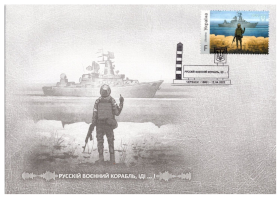 |
| Cameo | See: Embossing | |
| Cancel, Cancellation | To cancel a stamp is the act of applying a physical mark to its surface to invalidate it for further postal use. The resulting mark is itself known as a cancellation. Cancellations can take various forms, including manuscript cancellations, such as an official's initials or a hand-drawn line across the face of a stamp, or a postmark, applied by handstamp or high-speed machine. |  |
| Cancelled To Order (CTO) | Cancelled To Order stamps are stamps cancelled by the issuing postal authority specifically for the collector market, without the stamps ever having passed through the mail. Cancelled stamps with full original gum are more than likely Cancelled To Order, as unlike postally used stamps, they would never have been affixed to an envelope. |  |
| Cape Triangular, Cape Triangle | The Cape Triangular, issued on September 1st, 1853, was the first postage stamp of the Cape of Good Hope and the world’s first to feature a triangular design. Featuring the allegorical figure of Hope reclining on an anchor, the distinctive triangular design was chosen to make the stamps easily recognisable, helping postal workers distinguish between them and the standard rectangular British stamps used on incoming overseas mail. | 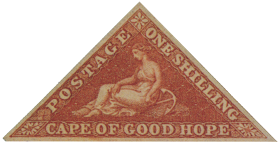 |
| Cartophilately | Cartophilately, derived from "cartography", the science of map-making, is a branch of philately that specialises in the study and collection of stamps and covers featuring maps in their design. |  |
| CDS | See: Circular Date Stamp | |
| Cello-Paq | Between 1961 and 1967, Canada Post issued sheets of 20 or 25 stamps packaged in cellophane envelopes known as Cello-Paqs. The intention was to give the public a convenient way of carrying a larger quantity of stamps than was possible with traditional booklets. |  |
| Centring, Centering (US) | Centring describes the position of a stamp's design relative to its outer edges. A stamp described as well-centred has a design precisely in the middle, with even margins on all four sides. Centring can have a marked effect on a stamp's value, particularly in the US, where its grade is largely determined by its centring. | 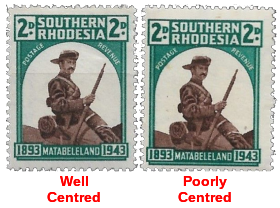 |
| CEPT | See: European Conference of Postal and Telecommunications Administrations | |
| Chalky paper | Chalky paper, also known as chalk-surfaced paper, is coated with a thin layer of a chalk-like compound before printing. This coating was introduced to help prevent the fraudulent reuse of postage stamps. If an attempt is made to remove a cancellation by washing the stamp, the coated surface is easily disturbed, damaging the printed design. Because of this, stamps printed on chalky paper require particular care when being soaked off their backing paper. Prolonged exposure to water can cause the coating to separate from the paper, resulting in permanent damage. One traditional method of identifying chalky paper is the "silver test". Gently touching the surface with a piece of metallic silver produces a dark, pencil-like mark. While this may be inconspicuous on used stamps, it will leave a permanent and often undesirable mark on mint examples. Chalky paper can also be identified under magnification. Compared to ordinary wove paper, it generally appears smoother, and the printed design often looks sharper, because the ink rests on the coated surface rather than being absorbed into the paper fibres. | |
| Chalon Head | Chalon Head is the informal name for a series of postage stamps issued by various British Colonies (including Canada, New Zealand and Natal) during the mid-to-late 19th century. The stamps feature a distinctive portrait of Queen Victoria based on a painting by Alfred Edward Chalon. |  |
| Changeling | See: Colour changeling | |
| Charity stamp | Charity stamps, also known as semipostals, are postage stamps that provide a convenient way for the public to donate to specific causes. While they perform the same primary role as any other definitive or commemorative stamps, they are sold at a premium above the regular postal service, with the extra amount, often indicated by a "+" on the stamp face, collected on behalf of a charity. While most catalogues place charity stamps chronologically within the main postage stamp section, others place them in the Back Of the Book section, where they are included along with a miscellany of non-postal items, such as telegraph and revenue stamps. |  |
| Charity seal, Charity label | Charity seals are stamp-like labels, or cinderellas, issued by charities to both raise funds and promote awareness of the charity. Unlike Charity Stamps, charity seals have no postal validity. However, they are frequently affixed to envelopes alongside regular postage stamps. Examples include Christmas Seals, TB Seals, and Easter Seals. |  |
| Chopmark, Chop | A chopmark, or chop, is a handstamp or seal applied to a postage stamp. It is not a cancellation and does not invalidate the stamp. For that purpose, a separate cancellation mark must be applied. Chopmarks derive from the East Asian tradition of using personal, corporate, and official ink seals as marks of authority and authentication. Classified by philatelists as auxiliary markings, they were applied by trading companies, banks, merchants, government offices, and, in some cases, military and occupation authorities for accounting, mail tracking, administrative, and security purposes. They are most closely associated with the postal history of China, Hong Kong, Japan, and the Treaty Ports during the nineteenth and early twentieth centuries, but were also used in territories under Japanese occupation during the Second World War, where handstamped markings served a variety of postal and administrative functions. The term is generally thought to derive from the Hindi chaap, meaning "stamp", "seal", or "mark". | 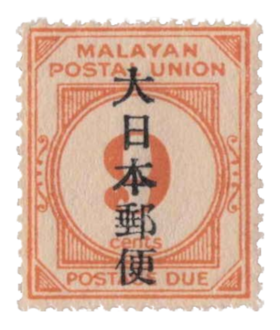 |
| Christmas stamp | Christmas stamps are Christmas-themed commemorative postage stamps used on seasonal mail to brighten the festive season Christmas stamps should not be confused with Christmas seals, which are not valid for postage. |  |
| Cinderella | Cinderellas are a broad category of collectable stamp-like labels that are not valid for postage. Once considered the "neglected step-sisters" of philately, hence the name, they have since attracted a dedicated following amongst specialist collectors. Examples include charity seals, exhibition labels, and poster stamps. The status of other non-postal stamps, such as telegraph and railway stamps, is less clear-cut. Many collectors regard them as cinderellas, while others treat them as separate collecting areas. Revenue stamps, by contrast, are generally excluded from the category and are instead considered a distinct category. |  |
| Circuit Book | A circuit book is a booklet of stamps for sale that is circulated amongst the members of a philatelic club or society. Members are permitted to remove any stamps they wish to purchase before passing the book to the next person on a pre-determined distribution list. After the "circuit" is complete, the book is returned to the society's secretary, who invoices members for the items they removed. See also: Approval Book. | |
| Circular Date Stamp (CDS) | A circular date stamp is a circular postmark that includes the date, time, and place of cancellation. | |
| Cliché, Cliche | Clichés are individual metal blocks that, when combined, create a complete printing plate, with each cliché responsible for printing a single stamp. When a cliché becomes worn or damaged, it can be replaced without affecting the rest of the printing plate. Sometimes, the replaced clichés may differ slightly from the original, allowing stamps printed from them to be uniquely identified; these are called substituted clichés. Modern printing plates are now made as a single unit with multiple impressions, called subjects, rather than being made up of individual clichés. | |
| Coil Stamp | Coil stamps are produced in long strips, one stamp wide, rather than in traditional sheets. They are typically wound into rolls (coils) for convenient dispensing, often through vending machines, and are also widely used in high-volume automated mailing systems. Depending on their format, coil stamps may have perforations only along the top and bottom edges, leaving one or both sides imperforate. | 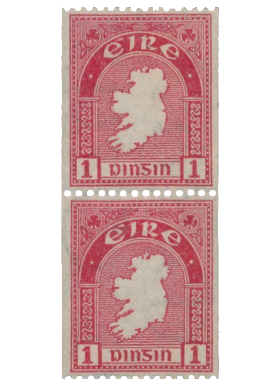 |
| Coincidental Variety | See: Transient Variety | |
| Colour changeling | A colour changeling (often referred to simply as a changeling) is a stamp whose colour has partially or entirely changed due to environmental factors such as exposure to sunlight, moisture, or airborne chemicals. These changes are unintentional and are generally considered damage rather than a distinct colour variety. The term is also used for stamps that have not yet changed colour but are known to be susceptible to such changes. |  |
| Colour Proof, Color Proof (US) | See: Proof | |
| Commemorative | Commemorative stamps are issued to mark special events or to honour a notable figure, place, or anniversary. Unlike definitive stamps, which are intended for long-term use, commemoratives are typically only available for a limited time. |  |
| Comb Perforation | Comb perforations are produced by a perforating machine that simultaneously perforates three sides of a stamp. Like harrow perforations, this results in uniform, well-aligned corners, unlike the often irregular corners seen with line perforations. | 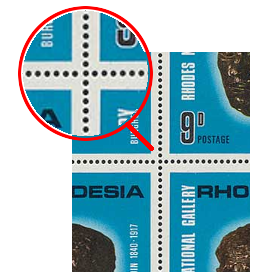 |
| Compound perforation | See: Perforation | |
| Constant Flaw | See: Flaw | |
| Constant Plate Variety | See: Flaw | |
| Constant Variety | A constant variety is a recurring deviation from the normal stamp that appears repeatedly in the same position on every sheet of stamps printed from a particular plate, cylinder, transfer roller, or printing unit. Constant varieties are typically caused by defects, damage, or alterations affecting the printing surface or production process. | |
| Context Philately | Context Philately, a relatively new term coined in 2023, refers to the study and collection of postage stamps and postal history within their historical, cultural, and social context. It emphasises understanding stamps not just as postal artefacts but also takes into account events or themes such as political change, historical events, or societal developments at the time of issuance. | |
| Control number | A control number is a sequence of letters or numbers printed in the margin of a sheet, primarily used by the post office for accounting purposes. Unlike plate numbers or cylinder numbers, which identify the printing device, a control number identifies a specific printing run or batch. | |
| Cork cancellation | Cork cancellations are postal markings applied by a cancelling device fashioned from a carved cork bottle stopper. |  |
| Counterfeits, Fakes and Forgeries | Although the terms counterfeit, fake, and forgery are often used interchangeably, in philately, each has a specific meaning.
| |
| Cover | Cover refers to an intact envelope, lettercard, lettersheet, wrapper, or other item of postal stationery that has been sent through the mail. When a cover is preserved in its complete, untrimmed, original form, retaining all stamps, postmarks, addresses, etiquettes, and any other postal markings, it is known as an entire. | |
| Crash Cover | A Crash Cover is mail salvaged from an aeroplane or vehicle accident that is eventually delivered to the intended recipient. Because mail is often severely damaged, postal authorities typically apply an official Salvaged Mail cachet to explain the delay and damage. In cases of extreme damage, the item may be delivered inside an Ambulance Cover, a larger, official envelope used to protect the fragile remains. While the Crash Cover term is typically reserved for air or rail accidents, mail recovered from maritime disasters is more accurately categorised as Wreck Mail. (image sourced from Wikimedia Commons). |  |
| CTO | See: Cancelled To Order | |
| Cutting guide line | See: Guide line | |
| Cylinder | A cylinder is a seamless, curved printing plate used on modern rotary printing presses. Unlike flat plates, cylinders allow for continuous high-speed production using rotogravure printing. Each cylinder usually represents a single colour, with multiple cylinders being used in sequence to create a multicoloured stamp. Cylinder numbers, which identify the specific cylinders, are often found in the sheet margin inscription. | |
| Cylinder number | A cylinder number, appearing in the margin of a sheet of stamps, serves a similar purpose to a plate number, but refers instead to stamps produced from a cylinder on a rotary press. In multicolour printing, multiple cylinders are typically utilised, typically, one per colour. While many postal administrations display a separate cylinder number for each colour, others may use a single consolidated number or a specific code to represent the set. |  |
D
A . B . C . E . F . G . H . I . J . K . L . M . N . O . P . Q . R . S . T . U . V . W . X . Y . Z| Dandy roll | A dandy roll is a wire mesh cylinder with an embossed pattern that impresses a watermark into wet paper during the papermaking process. (Image sourced from Wikimedia Commons). | 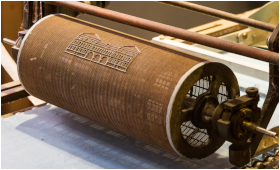 |
| Datestamp | A datestamp is a postmark that includes the date and, often, the time and place of cancellation. | |
| De La Rue | See: Thomas De La Rue & Co | |
| Definitive | Definitive stamps, also known as regular issues, are stamps issued for everyday postal use over an extended period. This contrasts with commemorative stamps, which are released to mark specific people, events, or anniversaries and are usually available only for a limited time. Definitives are typically issued in a range of denominations to meet current postal rates and services. Because they often remain in use for many years, they may be reprinted numerous times, resulting in variations in paper, watermark, perforation, colour, or printing method that are of particular interest to specialised collectors. | 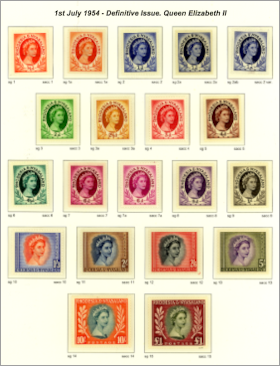 |
| Dead Country | In philately, a dead country is a stamp-issuing entity that has ceased to exist or no longer issues its own postage stamps. This may occur for a variety of reasons, such as political revolution, independence, military occupation, territorial changes, or consolidation of postal administrations. Dead countries appeal to many collectors because their stamp issues are finite. No new stamps will be added, making it a realistic and achievable goal to form a complete collection. | |
| Dead Letter | A dead letter, also known as undeliverable mail, is a postal item that cannot be delivered to an addressee because of an incorrect or incomplete address, and which, in the absence of a return address, cannot be returned to the sender. Many postal administrations operate a Dead Letter Office where these items are sent, and where authorised officials may open the mail to look for clues to the sender's identity. | |
| Dead Letter Office | Facilities responsible for processing dead letters were once commonly known as Dead Letter Offices. Today, the term is largely obsolete and has been replaced by more descriptive names such as "Mail Recovery Centre", "Return Letter Office", or "Undeliverable Mail Office", depending on the country and postal administration. | |
| Deltiology | Deltiology is the study and collection of picture postcards. The term derives from the Greek deltion, the diminutive of deltos, meaning "a writing tablet". | |
| Demonetised, Demonetized | Demonetised stamps are stamps that have been declared no longer valid for the payment of postage. This may be due to a currency change or a major political transition, such as a country gaining independence or a change of regime. | |
| Denomination | The denomination is the monetary value printed on a stamp, also known as its face value. It indicates the amount of postage prepaid by the sender. | |
| Design Error | A design error is a factual, linguistic, or artistic mistake that is included in a stamp's design and appears throughout the entire print run. Unlike production errors, which occur during printing, design errors occur during the stamp's conception or design phase. Because the error is part of the master plate or die, it is constant across all copies of the issue. Examples include spelling mistakes, incorrect dates, portraits, maps, heraldry, colours, or other factually incorrect elements of the stamp design. | 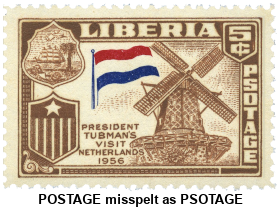 |
| Dickinson paper | See: Silk thread paper | |
| Die | A die is the original engraved piece of steel on which the stamp design is first created, usually by hand. Because it contains only a single subject, the engraver can refine the design to a high level of detail. Once complete, the die is hardened so that it can be used to produce multiple impressions. A master die may be used to create a transfer roller or subsidiary dies, which can be used to incorporate minor modifications such as changes in denomination or inscription. | |
| Die Proof | See: Proof | |
| Doctor blade | A doctor blade is a flexible steel blade used in recess printing to remove excess ink from the surface of the printing cylinder, leaving ink only in the engraved design. | |
| Doctor blade flaw | A doctor blade flaw is characterised by fine vertical or horizontal lines appearing on the surface of a stamp. It is typically caused by debris trapped under or attached to the doctor blade, creating a small gap that allows a thin line of ink to remain on the printing cylinder. The effect is usually transient. The lines may shift position, and further lines can often be prevented by cleaning. In severe cases, however, the debris may scratch the printing cylinder, resulting in a permanent or constant flaw. |  |
| Doubly Fugitive Ink | See: Fugitive Ink | |
| Double Head | Double Head is the popular name given to the Rhodesian definitive series issued between 1910 and 1913, featuring dual portraits of the future King George V and Queen Mary, based on photographs taken when they were the Duke and Duchess of Cornwall and York. Consisting of 18 denominations ranging from ½d to £1, the series is widely regarded as one of the most attractive and iconic stamp issues ever produced. Printed by the line engraving process, the stamps were produced in a wide variety of colours and from multiple printing plates, providing collectors with an extensive and fascinating field of study. | 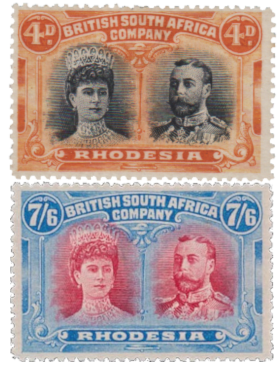 |
| Downey Head | The Downey Head is the name given to the first definitive stamps of King George V, issued in Great Britain on 22 June 1911. The stamps are named after the royal photographers W. & D. Downey, whose three-quarter portrait of the King formed the basis of the design. The series is notable for its short lifespan and limited scope. Only the halfpenny and one-penny denominations were issued before the design came under widespread criticism for its lack of depth and uninspiring appearance. Public and official dissatisfaction ultimately led to the series being replaced in 1912 by the more traditional profile portrait designed by Bertram Mackennal. |  |
| Duck stamp | Duck stamps are annual waterfowl hunting permits issued as revenue stamps in both Canada and the United States. These attractive stamps typically depict waterfowl and are highly collectable in their own right. In the U.S, the federal Migratory Bird Hunting and Conservation Stamp is issued by the U.S. Fish and Wildlife Service. Commonly known as the “Federal Duck Stamp”, it is required for waterfowl hunters aged 16 and over. In Canada, the equivalent issue is the Canadian Wildlife Habitat Conservation Stamp, issued by Wildlife Habitat Canada. The stamp is required to validate the Canadian Migratory Game Bird Hunting Permit, and proceeds support wildlife habitat conservation projects across Canada. |  |
| Dumb cancellation | See: Mute cancellation | |
| Dune stamps, Dunes | Dune stamps, or simply "the Dunes", is the collective term used by philatelists for the large number of colourful stamps issued by the Trucial States (precursors to the United Arab Emirates) during the 1960s and early 1970s. These included, amongst others, Ajman, Fujairah and Umm al-Quwain as well as related entities such as Manama. Produced primarily for the international collector market, often with pre-printed cancellations, many of these stamps bore little relation to the culture, geography, or postal needs of the issuing states, and comparatively few saw genuine postal use. Because they were printed in enormous quantities and were widely regarded as speculative issues aimed at collectors, they acquired a poor reputation within organised philately and were generally excluded from competitive exhibiting under the auspices of the Fédération Internationale de Philatélie. Today, although they remain popular with some thematic collectors, the term "Dune stamps" is often used pejoratively to describe stamps issued in excessive quantities primarily to exploit the collector market. | 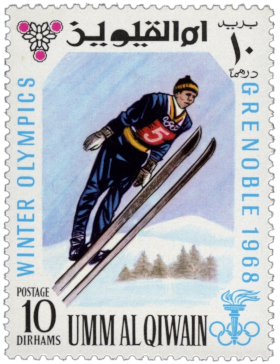 |
| Duplex cancellation | A duplex cancellation, also known as a duplex postmark, is a handstamp that combines a dated postmark and an obliterator in a single device. The postmark records the date and place of posting, while the obliterator cancels the stamp to prevent its reuse. The principal advantage of a duplex cancellation is that it allows the postmark to remain clear and legible while effectively still defacing the stamp. | 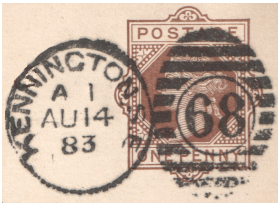 |
| Duty plate | A duty plate is a printing plate used to add the variable elements of a key type stamp design, such as the denomination, currency, and sometimes the name of the country or colony. |
E
A . B . C . D . F . G . H . I . J . K . L . M . N . O . P . Q . R . S . T . U . V . W . X . Y . Z| EFO | See: Errors, Freaks & Oddities | |
| Electro | See: Electrotype | |
| Electrotype | Electrotype plates for relief printing are produced by electroplating a copper layer onto a wax mould. Once the resulting copper shell has achieved the necessary thickness, it is removed and reinforced with molten metal to create a hard-wearing plate. The plate itself, or an individual subject of an electrotype plate, is sometimes abbreviated to electro. | |
| Embossing | Embossing creates a raised image on a stamp's surface by using a combination of raised and recessed dies to impress the image into the paper. Ink was sometimes used to add colour to all or part of the stamp design, often as a coloured background for a white-embossed portrait known as a cameo. Embossing is more commonly found on postal stationery than on stamps, which are typically produced using other printing methods. |  |
| Engraved | Engraving is a form of recess printing in which the design is cut directly into the surface of a metal plate or cylinder. The image is composed of precise, continuous lines, resulting in very sharp detail and strong contrast in the printed impression. Because the paper is forced into the inked recesses under great pressure, the ink is deposited in a thick layer, often giving the finished stamp a slightly raised feel. Line engraving is the term used by philatelists to describe the classic process in which a master design is hand-cut into a metal plate, usually copper or steel, with a tool called a burin. | |
| Engraver's Proof | See: Proof | |
| Entire | See: Cover | |
| Ephemera | Ephemera refers to collectable items, primarily printed or written material, that were originally intended for short-term use rather than long-term preservation. Examples include theatre posters, tickets, pamphlets, postcards, covers, and other postal or advertising material. The term derives from the Greek ephemeros, meaning "lasting only a day". | |
| Error | An error is a major and unintended deviation from the intended stamp design or production standards, usually resulting from a failure in the production process. Errors are generally constant by nature and often affect part or all of a print run. Examples include inverted centres, missing colours, incorrect watermarks, wrong paper, or major perforation mistakes. Errors are usually regarded as major varieties. See also: Design Error. | 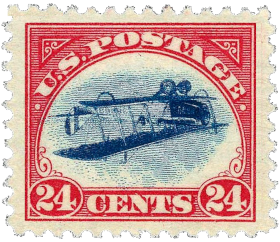 |
| Errors, Freaks & Oddities (EFO) | Errors, Freaks, and Oddities is a collective term used to describe stamps that deviate from their intended design or normal production standards. The category includes major production mistakes, accidental printing anomalies, and unusual one-off occurrences. Although the term is widely recognised, particularly amongst North American collectors and dealers, the distinction between freaks and oddities is not clearly defined and appears to be somewhat subjective. For this reason, many philatelists eschew the catchy slogan in favour of the broader and more neutral variety , which categorises these items based on whether the deviation is constant or transient. | |
| Essay | An essay is a proposed design for a postage stamp prepared for consideration by a postal authority. Essays may be unique works of art produced by hand or may be printed in small runs. Essays, when they appear on the philatelic market, are often highly collectable, with hand-drawn or hand-painted examples commanding a premium price. |  |
| Etching | Etching is a form of recess printing in which the design is created by coating a plate with a resist and using acid to bite lines into the exposed areas. The resulting lines hold ink below the surface, but are typically freer and less mechanically precise than those produced by line engraving. | |
| Etiquette | Etiquettes are adhesive labels affixed to envelopes or other postal items to indicate a particular postal service or handling requirement. Although most commonly associated with airmail labels, the term may also apply to other instructional or service labels, such as registration, express, or priority mail labels. The term derives from the French étiquette, meaning "ticket" or "label". |  |
| Europa Stamps | Europa stamps are an annual omnibus issue produced by European postal administrations to promote cooperation and unity within Europe. The programme was established in 1956 by the six member states of the European Coal and Steel Community (ECSC). Responsibility for coordinating the issues was later passed to the European Conference of Postal and Telecommunications Administrations (CEPT) in 1959, and subsequently to PostEurop in 1993. |  |
| European Conference of Postal and Telecommunications Administrations (CEPT) | The European Conference of Postal and Telecommunications Administrations (commonly known by its French acronym, CEPT) is the coordinating body for cooperation amongst European postal and telecommunications administrations. Established in 1959 by 19 member countries, CEPT was created to provide a forum for harmonising technical standards, operational practices, and regulatory policies across Europe. |  |
| Expertising mark, Expertizing mark | Expertising marks, often in the form of a hand-written signature or a small handstamp, are sometimes applied to the reverse of a stamp by a recognised expert or expertising authority to indicate that the item has been examined and is considered genuine. Such marks should, however, be treated with caution, as they can themselves be forged. A forged expertising mark applied to a forged stamp can be used to deceive collectors and falsely imply authenticity. | 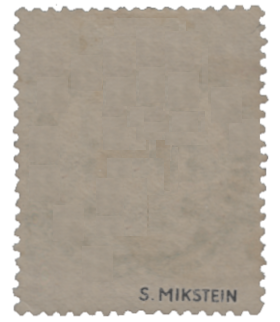 |
F
A . B . C . D . E . G . H . I . J . K . L . M . N . O . P . Q . R . S . T . U . V . W . X . Y . Z| Face value | See: Denomination | |
| Facing slip | A facing slip, also known as a bundle slip, is a label or form affixed to a bundled stack of mail during sorting to indicate its destination, route, and other essential handling instructions. Although the term is most commonly associated with the United States Postal Service (USPS), similar labels and routing slips have long been used by postal administrations worldwide to facilitate the orderly movement and distribution of mail. (Image of an RMS Titanic facing slip sourced from The Smithsonian). | 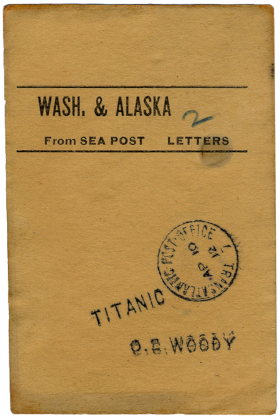 |
| Fake | See: Counterfeits, Fakes and Forgeries | |
| Farley's Follies | James A. Farley, United States Postmaster General from 1933 to 1940, had access to the first sheets of newly issued stamps directly from the printing press and before they were perforated or gummed. Farley gifted many of these unique sheets to President Franklin D. Roosevelt, an enthusiastic stamp collector. When it emerged that Farley had also distributed these rare sheets to political associates, friends and relatives, considerable controversy arose within the philatelic community. Collectors objected to preferential access to material that was unavailable to the public and likely to become highly valuable. To address the controversy, the Post Office Department reprinted the 20 issues as ungummed, imperforate sheets and made them available for sale to the general public. These reprints have since become known as Farley’s Follies. |  |
| FDC | See: First Day Cover | |
| Fédération Internationale de Philatélie (FIP) | Founded in Paris in 1926 and now based in Zurich, Switzerland, the Fédération Internationale de Philatélie (FIP) is an international federation of national and continental philatelic organisations. Its primary objectives include promoting philately internationally, fostering relations between collectors, postal administrations, and the philatelic trade, and promoting philatelic exhibitions. FIP grants patronage to World Stamp Exhibitions and establishes regulations and guidelines for competitive exhibiting and judging. |  |
| Fellow of the Royal Philatelic Society London (FRPSL) | Fellowship is a prestigious honour bestowed upon members of the Royal Philatelic Society London (RPSL). This distinction recognises individuals who have demonstrated exceptional dedication to the hobby, either through significant service to the Society itself or by making outstanding general contributions to the field of philately. Members who are granted this honour are entitled to use the post-nominal initials FRPSL after their name to signify their status as a Fellow. | |
| FFC | See: First Flight Cover | |
| FIP | See: Fédération Internationale de Philatélie | |
| First day cover (FDC) | A first-day cover (FDC) is a cover franked with one or more stamps, cancelled by datestamp on their official date of issue. In many cases, these covers also feature a cachet to highlight their first-day status. Originally, most of these cachets were simple text markings that were handwritten, typed, printed, or rubber-stamped. However, some collectors and artists also produced illustrated cachets featuring hand-drawn or hand-painted designs. By the 1960s and 1970s, however, stamp dealers were producing first-day covers with pre-printed illustrated cachets. Likewise, postal administrations began mass-producing high-quality official first-day covers, complete with pre-printed cachets and matching first-day postmarks, intended for the collector market. | 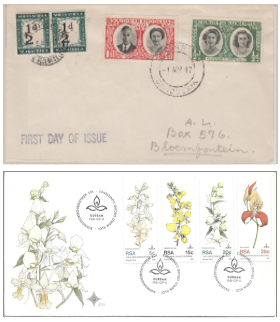 |
| First flight cover (FFC) | A first flight cover (FFC) is a cover carried on the inaugural flight of an aircraft, airline service, or particular air route. These covers are usually identified by a special cachet and cancellation applied for the occasion. |  |
| Fiscal | See: Revenue | |
| Flaw | A flaw is an imperfection that affects the design or appearance of a stamp. A printing flaw is a transient or non-constant variety caused by a temporary mishap during printing or handling. A plate flaw is a constant variety caused by damage, wear, or defects in the printing plate or cylinder. Other terms used for a plate flaw include constant flaw, plate variety and constant plate variety. | |
| Fluorescence, Fluorescent | See: Luminescence | |
| Fluorescent Paper | Fluorescent paper is treated during manufacture with chemical Optical Brightening Agents, also known as Fluorescent Whitening Agents, to artificially increase its whiteness. Stamps printed on fluorescent paper can be identified by the bright glow emitted under longwave ultraviolet (UV) light. | |
| Forever Stamp | Forever Stamps are non-denominated, first-class postage stamps issued by the United States Postal Service (USPS). These stamps are sold at the prevailing first-class letter rate at the time of purchase but remain valid for first-class postage indefinitely, regardless of any future price increases or rate changes. | 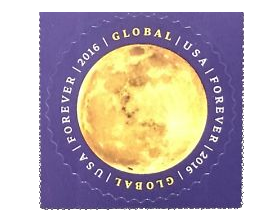 |
| Forgery | See: Counterfeits, Fakes and Forgeries | |
| Frama label | Frama labels are gummed postage labels dispensed by vending machines manufactured by the Swiss company Frama AG, with the denomination selected by the customer at the time of purchase. Unlike Klüssendorf machines, which generally printed only the value onto pre-printed label stock, Frama machines printed both the denomination and other postal information onto specially produced security paper. Due to Frama's pioneering specialised paper and vending technology and its widespread international adoption, collectors often use the brand name Frama as a generic term for the entire category of machine vended labels. | 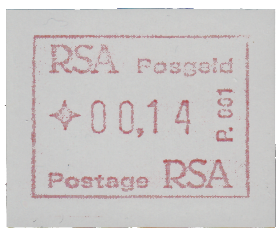 |
| Frank | A frank is an official marking applied to a postal item to indicate that postage has been prepaid or that the item is authorised for transmission through the post. Franks may take the form of adhesive postage stamps, postage meter impressions (metered mail), handstamps, or other authorised postal markings. A free frank is a signature, handstamp, or official marking such as an "On Her Majesty’s Service" cachet authorising the carriage of mail without prepaid postage, usually by virtue of official or governmental privilege. | 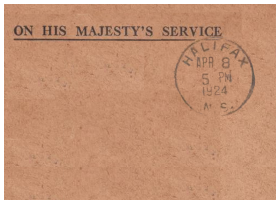 |
| Franking machine | See: Postage meter | |
| Freak | See: Errors, Freaks & Oddities | |
| FRPSL | See: Fellow of the Royal Philatelic Society London | |
| Fugitive Ink | Fugitive inks are printing inks designed to dissolve, bleed, or run when exposed to water or other solvents. Developed as a security measure to prevent the fraudulent cleaning and reuse of previously cancelled postage stamps, these inks ensure that any attempt to wash away the cancellation or soak a used stamp off an envelope will visibly damage the stamp's design. In modern philatelic terminology, singly fugitive refers to inks damaged by water, whereas doubly fugitive inks are susceptible to both water and chemical solvents. Historically, however, in the terminology used by the printers Thomas De La Rue & Co, singly fugitive inks were water-resistant, allowing stamps to be safely soaked from envelopes, but would run if exposed to chemical solvents, whilst doubly fugitive inks were vulnerable to damage from both water and chemical solvents. | 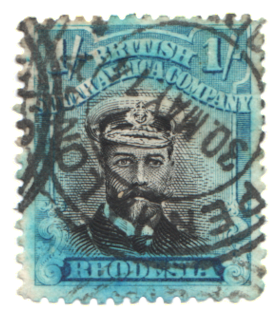 |
| Fugitive Stamp | Fugitive stamps are stamps printed with fugitive ink or on a water-sensitive coating, such as chalky paper. By design, these components act as a security measure to prevent the fraudulent reuse of previously cancelled postage stamps, as any attempt to remove the cancellation or soak the stamp off an envelope will inevitably damage or destroy the printed design. |
G
A . B . C . D . E . F . H . I . J . K . L . M . N . O . P . Q . R . S . T . U . V . W . X . Y . Z| General delivery | See: Poste restante | |
| Glassine | Glassine paper is a thin, translucent, supercalendered paper with excellent resistance to air, moisture, and grease. In philately, it is widely used for stamp storage envelopes (commonly referred to simply as glassines), album interleave sheets, and traditional stamp hinges. Supercalendered paper is paper that, during the final stage of manufacture, has been passed under intense pressure through a series of heavy, heated rollers, known as calenders. This process compresses the paper fibres, producing an exceptionally smooth, grease-resistant surface with a high gloss finish. |  |
| Granite paper | Granite paper is a distinctive type of postage stamp paper in which small, coloured fibres are embedded directly into the pulp during manufacture. These fibres, visible to the naked eye as tiny coloured threads, were introduced primarily as a security measure to deter forgery and counterfeiting. |  |
| Graphite lines | Graphite lines, which are electrically conductive, were printed on the reverse of certain values of the British Wilding definitive stamps between 1957 and 1959 as part of the General Post Office’s experimental automated mail-sorting programme. The lines allowed automated sorting machinery to detect the stamp's position on an envelope in order to orient letters during processing. This experiment was short-lived, as the technology was quickly superseded by phosphor bands. | 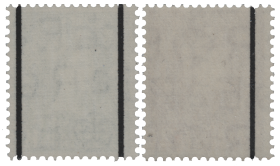 |
| Gravure | Gravure is a general printing term for recess printing processes, but in philately, it is commonly used as shorthand for photogravure rather than for all forms of recessed printing. | |
| Grill | A grill is an embossed pattern of small lines or dots impressed into the paper of a postage stamp as a security measure to deter fraudulent reuse by making the cancellation difficult to remove. This technique was used primarily in the United States between 1867 and 1871, and in Peru between 1874 and 1879. In US philately, several distinct grill patterns were employed. For catalogue purposes, each pattern was assigned a letter identifier (such as the A, B, or C Grill) based on the size and shape of the impression. The Z Grill pattern is particularly scarce; the 1868 1¢ Benjamin Franklin Z Grill, with only two known examples, is widely considered the rarest and most valuable of all American postage stamps. | 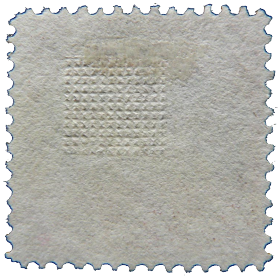 |
| Guide line | Guide lines are thin lines printed between rows and columns of stamps to assist in perforating stamp sheets or cutting them into smaller panes. They served as alignment aids during the production process and are sometimes visible in the margins or between adjoining stamps. When a sheet of stamps passed through the perforating machine, the perforations were punched directly along these lines, often leaving tiny remnants of the guide line visible within the perforation tips or, occasionally, leaving part of the guide line visible adjacent to the perforations. These lines are often referred to simply as printer's marks. However, the term printer’s marks has a much broader meaning and also includes other marginal markings added by the printer to assist with alignment, registration, cutting, perforating, and other aspects of stamp production. | 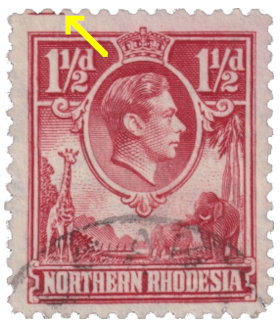 |
| Gutter | Gutters are the margins that divide a large sheet of stamps into separate panes. While gutters are typically blank, they may contain various printed markings such as guide lines, traffic lights, cylinder numbers or plate numbers. | 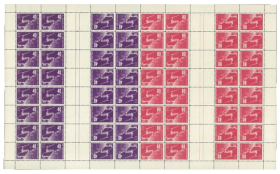 |
| Gutter snipe Guttersnipe | Gutter snipe is a term used primarily by collectors of U.S. stamps to describe a stamp that has a full, adjacent gutter attached, along with the perforations and, sometimes, a small portion of the design of the adjoining stamp. This occurs when a sheet of stamps is misaligned during the cutting process, causing the blade to strike outside the intended gutter space. |  |
H
A . B . C . D . E . F . G . I . J . K . L . M . N . O . P . Q . R . S . T . U . V . W . X . Y . Z| Handstamp Hand stamp | A handstamp is a handheld device used by postal workers to apply postmarks, cancellations, cachets, or instructional markings manually to mail. A postal item marked in this way is described as being handstruck. In philatelic usage, the term "handstamp" may refer to either the device itself or the impression it leaves on the envelope or cover. |  |
| Handstruck | See: Handstamp | |
| Harrow Perforation | Harrow, or Sheet perforations, are produced using a large plate of pins that simultaneously punch all holes in a sheet of stamps. Like comb perforations, this method produces uniform, well-aligned corners. A disadvantage of harrow perforating is that the pins are fixed, which makes the equipment suitable for only one size of stamp. | |
| Head plate | See: Key plate | |
| Health Stamps | Health stamps are a long-running series of New Zealand Charity Stamps issued between 1929 and 2016, which also included a surcharge to raise funds for Children’s Health Camps. |  |
| Hinge | A stamp hinge is a small, folded strip of thin, gummed glassine paper used to mount stamps in an album. When lightly moistened, it secures the stamp to the page while allowing it to be hinged back for examination of the reverse. | 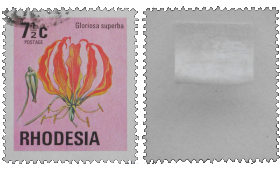 |
| Humidor | See: Sweatbox |
I
A . B . C . D . E . F . G . H . J . K . L . M . N . O . P . Q . R . S . T . U . V . W . X . Y . Z| Imperforate | Imperforate stamps are issued without any mechanical means of separation, such as perforations or rouletting, and must therefore be cut from the sheet by hand, leaving straight edges. Stamps are not necessarily imperforate on all four sides; for example, coil stamps are often manufactured with perforations along the top and bottom edges, while one or both of the vertical sides remain imperforate. | 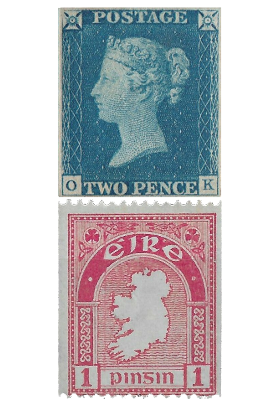 |
| Imprimatur | An imprimatur is a specially approved sheet of stamps printed from a new or altered plate, essentially a plate proof. This allowed the sheet to be checked for errors before the plate was officially approved and put into full production. The term is generally associated with Great Britain's Victorian-era stamps. It derives from the Latin word imprimatur, meaning "let it be printed". | |
| Indicium, Indicia (pl.) | Indicia are printed markings or franks on postal items indicating that the sender has prepaid the required postage. Rather than using an adhesive stamp, an indicium is either pre-printed directly onto an envelope, card, or wrapper, as seen on postal stationery, or applied mechanically using a commercial postage meter. |  |
| Inscription | See: Marginal Inscription | |
| Intaglio Printing | See: Recess printing |
J
A . B . C . D . E . F . G . H . I . K . L . M . N . O . P . Q . R . S . T . U . V . W . X . Y . Z| JNF Stamps | JNF stamps are charity labels issued by the Jewish National Fund (JNF). The JNF, known in Hebrew as Keren Kayemeth LeIsrael (KKL), was established in 1901 as a non-profit organisation to raise funds for the purchase and development of land in Ottoman Palestine, and later in Israel. |  |
| Joint Issue | Joint issues occur when two or more independent postal administrations simultaneously issue stamps that share a common design, theme, or subject to commemorate a shared event or relationship. Joint issues differ from omnibus issues, which are usually produced by politically or administratively related postal authorities and often involve a much larger number of participating territories or countries. | 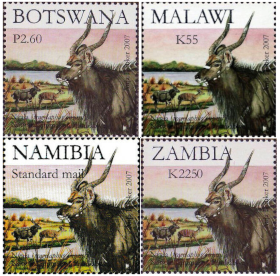 |
| Jubilee Line | Jubilee lines are coloured guide lines printed in the selvedge (sheet margins) of certain stamps of Great Britain and the British Colonies. They first appeared around the time of Queen Victoria’s Golden Jubilee in 1887, from which their name is derived. The lines were introduced as protective markings during the printing process. They absorb the initial impact from the printing rollers, helping to reduce wear and damage to the stamp impressions at the edges of the printing plate. |  |
K
A . B . C . D . E . F . G . H . I . J . L . M . N . O . P . Q . R . S . T . U . V . W . X . Y . Z| Key plate | A key plate, sometimes known as a head plate when it includes the portrait of a monarch or other official, is used to print the shared elements of a key type stamp design. The remaining details, such as the denomination or colony name, are added using separate duty plates. | |
| Key type Keytype | Key type stamps employ a common basic design for stamps issued by multiple postal administrations. A key plate prints the common design elements, while a duty plate adds variable details such as the denomination and, in some cases, the name of the country or colony. | 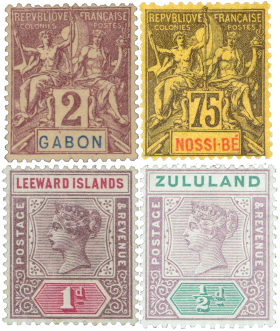 |
| Killer | See: Obliterator | |
| Kiloware | Kiloware is an unsorted mixture of used stamps, often still on paper, sold by weight. Hence the name kiloware, a portmanteau of ‘kilogram’, the metric unit of weight, and ‘ware’, a reference to goods for sale. |  |
| KKL | See: JNF Stamps | |
| Klüssendorf (Klussendorf) | Klüssendorf was a German manufacturer of vending machines that dispensed gummed postage labels or machine vended labels. Klüssendorf machines typically printed only the denomination onto pre-printed label stock, whereas Frama machines printed both the denomination and other postal information onto specially produced security paper. Following financial difficulties, Klüssendorf ceased trading in the late 1990s. | 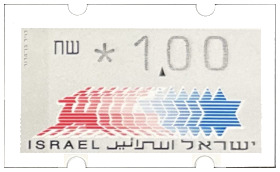 |
L
A . B . C . D . E . F . G . H . I . J . K . M . N . O . P . Q . R . S . T . U . V . W . X . Y . Z| Lacquer bars | See: Varnish bars | |
| Lettercard, Letter card | A lettercard consists of a folded sheet of thin card designed to be written on the inner surface, folded in half, and sealed using gummed margins. Perforated edges run along the border, allowing the recipient to tear open and read the card without damaging the message inside. When issued by a postal authority with a pre-printed indicium, it is classified as postal stationery. |  |
| Lettersheet, Letter sheet | A lettersheet consists of a folded sheet of thin paper designed to be written on, folded to form its own envelope, and sealed using gummed flaps. When issued by a postal authority with a pre-printed indicium, it is classified as postal stationery. | 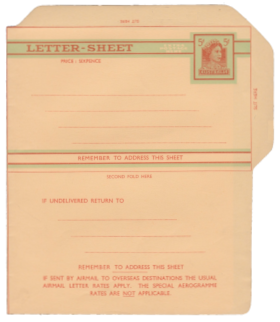 |
| Letterpress Printing | See: Relief Printing | |
| Line perforation | Line perforation is a process in which the horizontal and vertical rows of holes are perforated independently, resulting in irregular corners that are often ragged or broken, unlike comb or harrow perforations that form uniform corners. |  |
| Line Engraved Printing | See: Engraved | |
| Lithography | Lithography is a planographic printing printing process in which the image is transferred from a flat surface, rather than from raised or recessed areas. It is based on the principle that oil and water do not mix. The image areas are treated to attract oily ink, while the non-image areas attract water and repel the ink. In traditional direct lithography, the image is transferred directly from the plate to the paper. In modern practice, however, most lithographic printing, including stamp production, is carried out using Offset lithography , in which the image is first transferred to a rubber blanket before being printed onto the paper. Stamps printed by lithography are characterised by a smooth, flat appearance with no physical impression and, under magnification, typically show a dot-based structure rather than engraved lines. | |
| Luminescence, Luminescent | Luminescence is the glow emitted by phosphorescent or fluorescent materials when stimulated by ultraviolet (UV) light.
|
M
A . B . C . D . E . F . G . H . I . J . K . L . N . O . P . Q . R . S . T . U . V . W . X . Y . Z| Machin | First issued in 1967, the Machin series is a long-running British definitive stamp series based on Arnold Machin’s iconic sculpted plaster profile of Queen Elizabeth II, which remained in use until her death in 2022. |  |
| Machine Vended Label | Machine vended labels are postage labels dispensed by automated vending machines. Many are variable value issues, with the specific denomination selected by the customer at the point of purchase. In Europe, they are commonly known as ATM stamps, an abbreviation of the German term Automatenmarken (automatic stamps). Two of the better-known manufacturers of vending machines and associated postage labels were Frama AG of Switzerland and Klüssendorf of Germany. | |
| Machine cancellation | A machine cancellation is a postal marking applied by a machine, rather than by handstamp. | 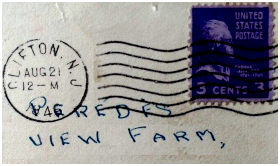 |
| Major variety | See: Variety | |
| Maltese Cross | The Maltese Cross obliterator was the first official cancellation used by the British Post Office to prevent the reuse of postage stamps. It was introduced in 1840 along with the world’s first adhesive postage stamps, the Penny Black and Two Pence Blue. Originally struck in red ink, the cancellation was changed to black ink in 1841. |  |
| Manuscript cancellation | A manuscript cancellation, also known as a pen cancellation, is a cancellation mark applied by hand using a pen or similar writing implement. This frequently takes the form of initials or a signature, sometimes supplemented by a date, or simply two crossed lines. Although manuscript cancellations were occasionally used on mail, they are often associated with fiscal use, particularly on stamps valid for both postage and revenue purposes. |  |
| Marcophilately | Marcophilately, also known as marcophily, is the study and collection of postmarks, cancellations, cachets, and other postal markings. From the French word Marcophilie, meaning "the study and collection of postal markings". | |
| Marcophily | See: Marcophilately | |
| Marginal inscription | Marginal inscriptions, also known as marginal markings, are letters, numbers, or symbols printed on the selvedge surrounding the stamps on a sheet or pane.These markings can include valuable information regarding the production of the issue. Common marginal inscriptions include: Plate Numbers, Cylinder Numbers, Control Numbers, Traffic Lights, Imprints, Guide Lines and Sheet Value: the total monetary value of the stamps contained in the sheet. | |
| Marker Monkey | A derogatory term for a postal worker who cancels a stamp with such enthusiasm that, at the stroke of a pen, any aesthetic appeal that the stamp may have had for a collector is destroyed. | 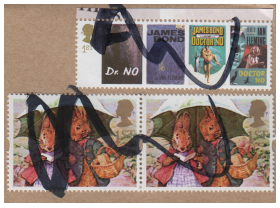 |
| Maximaphily | Maximaphily is the study, collection and creation of Maximum cards. | |
| Maximum card, Maxicard | Maximum cards, commonly known as maxicards, are picture postcards with a postage stamp affixed to the picture side, and cancelled with a postmark related to the card's subject. The postcard, stamp, and cancellation should share a common theme or subject, though the images themselves need not be identical. | 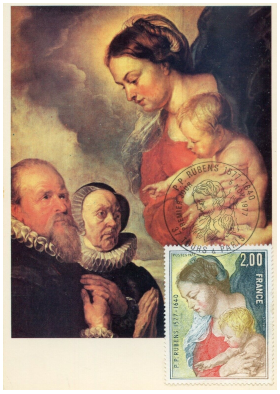 |
| Metered mail | Metered mail is mail that has been franked by a postage meter. In accordance with UPU regulations, the postage meter impression, or indicium, is normally printed in red in the top right-hand corner of the postal item. | 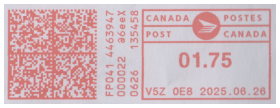 |
| Military Telegraphs | See: Telegraph stamps | |
| Miniature sheet, mini sheet, (MS) | A miniature sheet, also known as a souvenir sheet, is a small sheet containing one or more postage stamps. Generally issued to commemorate a special event, anniversary, or occasion, these sheets often feature wide, decorative margins containing relevant text, illustrations, or extended artwork that complement the stamp design. While designed primarily as a collectable item, the individual stamps within the sheet remain fully valid for postal use. |  |
| Minor variety | See: Variety | |
| Missing imprimatur | A removed imprimatur position is the gap left after a stamp has been cut from an archived imprimatur sheet. When plating a stamp against such a sheet, if a stamp cannot be matched to a known position, it is assumed that the stamp must originate from one of these vacant positions and is referred to as a 'missing imprimatur'. | |
| Mulready | First issued by Great Britain on May 1st, 1840, these prepaid envelopes and lettersheets are known as Mulreadys after the designer, the prominent artist William Mulready. Despite their artistic pedigree, they proved unpopular and were soon replaced. | 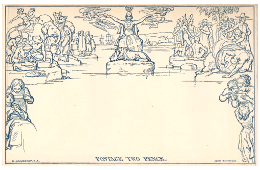 |
| Mute cancellation | A mute cancellation, also known as a dumb cancellation, is a postal marking devoid of identifying information, such as the date, time, or office of origin. |  |
N
A . B . C . D . E . F . G . H . I . J . K . L . M . O . P . Q . R . S . T . U . V . W . X . Y . Z| Newspaper wrapper | See: Wrapper | |
| Newspaper stamp | Newspaper stamps were issued specifically for the prepayment of postage on newspapers, periodicals and other printed matter, often at a reduced rate. In the United States, however, these stamps featured high face values because they were intended for bulk mailing, a departure from the low-value stamps typically used by other postal administrations. |  |
| Non-constant Variety | See: Transient Variety | |
| Non-denominated | Non-denominated postage stamps are issued to cover a specific level of service at the prevailing rate. They remain valid for that service indefinitely, regardless of any future price increases. Rather than displaying a numeric face value, these stamps typically indicate the service level through a letter code or a specific inscription. While commonly referred to as Non-value Indicator (NVI) stamps, many postal authorities use their own specific terms. For instance, the United States refers to them as Forever Stamps. |  |
| Non-machineable, Non-machinable | Non-machineable stamps are Forever Stamps issued by the United States Postal Service. They include a surcharge for mail that cannot be processed by standard automated sorting systems. | 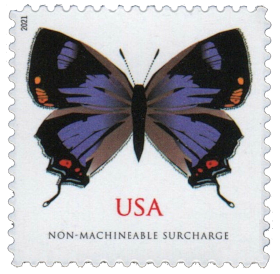 |
| Non-value Indicator (NVI) | An alternative term for non-denominated postage stamps. | |
| NVI | See: Non-value Indicator |
O
A . B . C . D . E . F . G . H . I . J . K . L . M . N . P . Q . R . S . T . U . V . W . X . Y . Z| Obliterator | An obliterator is a type of postal cancellation whose primary purpose is to deface a stamp and prevent its reuse. It is sometimes referred to as a killer, particularly when the cancellation is so heavy that it obscures most of the stamp’s design. The term may also refer specifically to the obliterating portion of a duplex cancellation, the part applied directly to the stamp. | 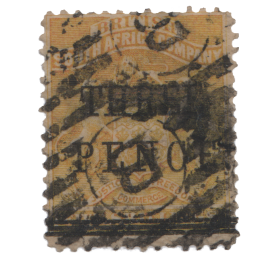 |
| Oddity | See: Errors, Freaks & Oddities | |
| Odontometer | See: Perforation gauge | |
| Official | Official postage comprises stamps or postal stationery reserved exclusively for governmental use. While some postal authorities issued dedicated envelopes and stamps, many simply marked regular postage stamps with overprints or perfins to distinguish them for official business. | 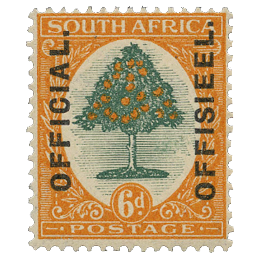 |
| Offset Lithography | See: Lithography | |
| Offset Printing | Offset printing is a method of printing that utilises an intermediate rubber blanket to transfer the image from the printing plate to the paper. The image is not printed directly from the plate, instead, it is "offset" onto the rubber surface, which then applies the ink to the paper. Offset printing allows for high-speed, high-volume production and is well-suited to large print runs. The flexible rubber blanket conforms to the paper's surface, producing a consistent image even on slightly textured stock. Offset printing is most often used in conjunction with lithography. | |
| OHMS | OHMS: On His/Her Majesty's Service British Commonwealth postal stationery is franked with the initials OHMS or the full text "On His/Her Majesty's Service" to denote official government use. These initials were also applied to regular Canadian stamps, and possibly those of other Commonwealth nations, via overprints or perfins to designate them for official business. | 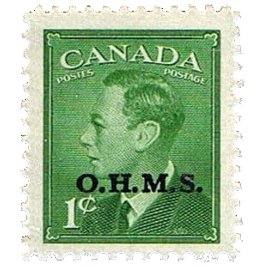 |
| Omnibus | Omnibus issues are postage stamps or sets of stamps issued by several postal entities to commemorate a common event or theme. The stamps generally share a common design, often, though not always, in the form of key type stamps. In most instances, the issuing administrations are politically linked, such as a group of colonies or members of a shared organisation, such as the British Commonwealth. Omnibus issues are distinct from joint issues, which are typically far more restricted in scope and are issued by independent postal administrations. |  |
| On piece | "On piece" refers to a used stamp that has been kept on a portion of the original cover, ideally including all or part of the cancellation or postmark. If the cancellation overlaps both the stamp and cover, it is described as tied. |  |
| OS | OS (Official Service) Postage stamps of Australia were overprinted or perfined with the letters 'OS' to indicate that they were intended for official use. | 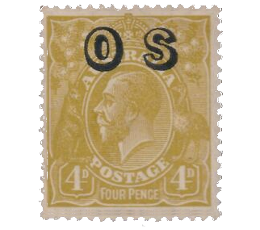 |
| Overprint | An overprint is additional text or a design added to the face of a stamp after its initial production. This may indicate a change in function or postal status, use within a different territory, or the commemoration of a specific event. A surcharge is a specific type of overprint that alters the face value of a stamp. This typically occurs in response to a change in currency, a shortage of a specific denomination, or a change in postal rates. |  |
| Oxidation | See: Sulphurisation |
P
A . B . C . D . E . F . G . H . I . J . K . L . M . N . O . Q . R . S . T . U . V . W . X . Y . Z| Paquebot | Paquebot (French for ‘ocean liner’): Refers to an item of mail posted aboard a vessel while at sea. Under UPU regulations, mail may be posted on the high seas using the postage stamps and postal rates of the country to which the ship belongs (its country of registration). These items are handed over to the postal authorities at the next port of call, where the stamps are cancelled, and a paquebot marking is applied, either separately or as part of the cancellation. |  |
| Pen cancellation | See: Manuscript cancellation | |
| Perfin | A perfin (a contraction of ‘perforated initials’) is a postage or revenue stamp that has been punched with a pattern of small holes to form letters, numbers, or symbols. These serve several distinct purposes, such as fiscal cancellations, precancels, or to discourage employee pilfering when perforated with a company's initials. |  |
| Perforation, Perf (abbrev) | Perforations are rows of small holes punched between stamps to facilitate easy separation. For collectors, a vital characteristic of any stamp is its perforation gauge, the number of holes within a 20mm (2cm) span, measured with a device called a perforation gauge. Compound perforations occur when the perforation measurements differ on adjacent sides, most commonly between the horizontal and vertical edges. In such cases, the horizontal measurement is always cited first; for example, ‘perf 12×14’ indicates that the top and bottom edges are perf 12, while the sides are perf 14. Most stamps are perforated using the line, comb, or harrow methods, with the comb technique being the most prevalent in modern production due to its efficiency and uniformity. | |
| Perforation gauge, Perf gauge | A perforation gauge, also known as an odontometer, is used to measure the number of perforations within a 20mm (2cm) span along the edge of a stamp. |  |
| Perforation guide line | See: Guide line | |
| Philatelic | The term philatelic refers to the study and collection of postage stamps, postal history, and related material. However, the word can also carry a more negative connotation when used to describe stamps, covers, or other postal items produced specifically for the collector market rather than for genuine postal use, such as philatelic covers. | |
| Philatelic cover | A philatelic cover is a cover prepared specifically for philatelic purposes rather than for carrying ordinary commercial or personal correspondence. Examples include first day covers, commemorative covers, and souvenir covers. |  |
| Philately | Philately is the study and collecting of postage stamps and related material, such as postmarks, postal history, and postal stationery. From the Greek, philo meaning "love" and ateleia meaning "tax exempt". | |
| Phosphor bands, Phosphor bars | See: Tagging | |
| Phosphorescence, Phosphorescent | See: Luminescence | |
| Photogravure | Photogravure is a form of recess printing in which a photographic process is used to transfer the image onto a plate or cylinder. Instead of engraved lines, the image is broken into a fine pattern of cells or dots, of varying size or depth, that hold different amounts of ink, producing a continuous-tone effect similar to a photograph. Under magnification, the edges of the design resolve into a dot or cell structure rather than the clean, sharp lines seen in line engraving. | |
| Planographic Printing | A method of printing from a flat surface, such as used in lithography, as opposed to the incised surface used for recess printing or the raised surface used for relief printing. | |
| Plate, Printing plate | A printing plate is a surface, generally made of metal, that carries multiple impressions of a stamp design. When inked, these impressions are transferred onto paper or, in the case of offset printing, onto an intermediary "blanket" before being transferred to the paper. The image areas of the plate may be raised, as in relief printing, or recessed, as in recess printing. Historically, plates were often constructed from multiple clichés, individual stamp images, secured together in a frame, or "chase". Modern plates are typically formed from a solid metal sheet with multiple copies of the design on its surface. While earlier plates were flat, modern versions are formed into cylinders for use on high-speed rotary presses. | |
| Plate Flaw | See: Flaw | |
| Plate number | A plate number is a numeral, and sometimes a letter, appearing in the margin of a sheet of stamps to identify the specific printing plate used. Some early British issues, such as the Penny Red, had the plate number engraved into the design of each individual stamp. | |
| Plate Proof | See: Proof | |
| Plate Variety | See: Flaw | |
| Plating | Plating is the process of identifying the exact position of an individual postage stamp within the original printing plate from which it was printed. This is possible, particularly with older line-engraved issues, because often, the individual positions on a plate exhibit minor but constant variations or flaws that enable the stamp’s original position to be determined. When examples from every position on the plate have been assembled, the resulting arrangement is known as a reconstructed sheet. | |
| Postage due | Postage due is the specific amount payable by the addressee when a piece of mail is sent with insufficient prepaid postage to meet the required level of service. A Taxe mark or Postage Due Label is applied to the item to indicate the exact amount to be collected before delivery can be completed. | |
| Postage due label | A Postage Due label is a stamp-like label affixed to a postal item to indicate the amount the addressee must pay before delivery can be completed. Certain higher-denomination British Postage Due labels were further inscribed "TO PAY", indicating that they could also be used to collect customs charges and other postal fees payable before delivery. |  |
| Postal card | Postal cards are issued by official postal authorities and feature a printed stamp-like indicium signifying that postage has been prepaid. They differ from postcards, which are commercially produced and require an adhesive stamp to be applied before mailing. Consequently, postal cards are classified as postal stationery. |  |
| Postal Code, Post Code, Postcode | A postal code is a unique sequence of letters, numbers, or a combination of both, included in a postal address to facilitate the automated and efficient sorting of mail. Examples:
| |
| Postage meter | A postage meter, also known as a franking machine, prints postage directly onto an envelope or onto a specialised adhesive strip, which can then be affixed to larger items. Prepaid postage is loaded onto the machine as credit via the relevant postal authority. Items processed in this manner are known as metered mail. | 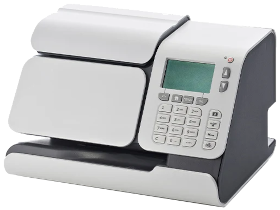 |
| Postal history | Postal History focuses on the movement of mail through the postal system, including the study of its operation and the development of postal rates, routes, and services. It examines stamps, postmarks, and covers as evidence of the specific journey a piece of mail has taken. | |
| Postal stationery | Postal stationery refers to prepaid postal items that bear a printed stamp-like indicium rather than an adhesive stamp applied separately. Common examples include aerogrammes, lettercards, lettersheets, wrappers and postal cards. | |
| Postcard | Postcards are designed to be mailed without an envelope. However, unlike postal cards, they do not include prepaid postage. Instead, the sender must affix an adhesive stamp before mailing. Postcards featuring a photograph or illustration on the front are primarily produced for the tourist market. The reverse of the card typically provides space for a written message from the sender along with the recipient’s address. The study and collection of postcards is known as deltiology. |  |
| Poste restante | Poste Restante (French for ‘post remaining’): Also known as General delivery in North America, is a postal service where mail is held at a specific post office for collection by the recipient. The service is primarily used by travellers, or individuals who are temporarily without a fixed address. | |
| Poster stamp | Poster stamps are decorative stamp-like labels or cinderellas that are not valid for postage. As the name suggests, they are designed to resemble miniature advertising posters and are typically produced to promote a product, charity, or specific event. |  |
| PostEurop | PostEurop is the trade association representing European public postal operators.
Established in 1993 to promote greater cooperation, sustainable growth and continuous innovation for the European postal sector, it is the official Regional Union for Europe within the Universal Postal Union (UPU). |  |
| Postmark | A postmark is an official marking applied to a postal item by a postal authority. The term encompasses several specific types of markings, including cancellations, transit marks, and receiving marks. | |
| Precancel | Precancels are stamps that have been cancelled, typically by means of an overprint, prior to being affixed to the mail. Precancels are primarily used for high-volume bulk mail, allowing items to bypass the initial cancellation stage and be delivered directly to the sorting office. This streamlines the process for the postal service, ensuring more efficient delivery. | 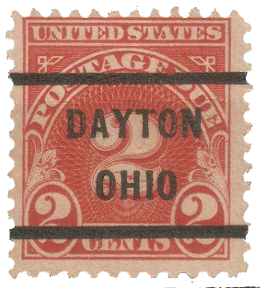 |
| Press sheet | Press sheets, also known as printer's sheets, are full-sized sheets of stamps that have not yet been guillotined or perforated into individual panes for distribution to post offices. While traditionally a part of the internal production process, many postal authorities have taken the opportunity to commercialise press sheets by issuing limited editions specifically for the collector market. | 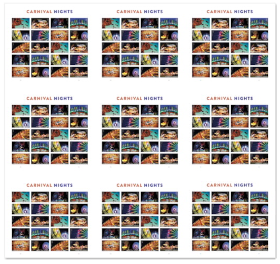 |
| Prestige Stamp Booklet (PSB) | Prestige Stamp Booklets are multi-page booklets that contain a series of stamps on a common theme, complemented by detailed descriptive text and imagery. Britain’s Royal Mail pioneered the format in December 1969 with the release of "Stamps for Cooks". The concept was subsequently adopted by postal authorities worldwide and is now a staple feature of many modern stamp issuing programmes. |  |
| Prexies | Prexies is the informal name for the 1938 United States Presidential Series, a long-running set of definitive stamps. The series features the 29 U.S. Presidents who served between 1789 and 1928, with the denominations generally corresponding to their order in office. For example, the 1c stamp features George Washington (1st President) and the 2c features John Adams (2nd President). While the sequence is primarily presidential, the set also includes a few honorary non-presidential subjects on fractional values, such as Benjamin Franklin on the ½c stamp. | 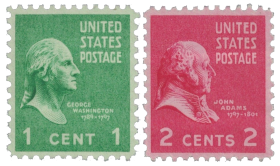 |
| Printer's mark | See: Guide line | |
| Printer's waste | Printer's waste refers to faulty philatelic material generated during the normal stamp production process that should have been discarded or destroyed. Instead, these items, which may include miscut, poorly perforated, or incorrectly inked stamps, often find their way into the philatelic market through unauthorised or illicit means. | |
| Printing methods | The three main printing methods used in stamp production: | |
| Proof | Proofs are trial impressions taken at various stages of the stamp production process to verify the design, engraving, or colour. They are not intended for postal use and generally fall into the following categories:
| |
| Provisionals | Provisional stamps (or provisionals) are stamps issued for temporary use when the regular supply of postage stamps is exhausted or unavailable. These issues are typically born of necessity during periods of upheaval, such as war, natural disasters, or abrupt changes in government. In most cases, provisional stamps are ordinary stamps which have been bisected, overprinted, or surcharged. A classic example occurred during the Siege of Mafeking (October 1899 - May 1900), when stamps from the Cape of Good Hope and British Bechuanaland were overprinted with "Mafeking Besieged" to maintain postal operations. Due to their limited production and short period of use, provisionals are highly sought after by collectors for their rarity and historical significance. |  |
| PSB | See: Prestige stamp booklet |
Q
A . B . C . D . E . F . G . H . I . J . K . L . M . N . O . P . R . S . T . U . V . W . X . Y . Z| No Entries |
R
A . B . C . D . E . F . G . H . I . J . K . L . M . N . O . P . Q . S . T . U . V . W . X . Y . Z| Receiving mark | Receiving marks, also known as arrival marks, are postmarks applied by the destination post office to document the arrival of an item. These marks typically include the name of the receiving office, the date, and sometimes the time of receipt. Receiving marks are often placed on the reverse of the envelope as a backstamp. | |
| Recess Printing | Recess printing, commonly known as intaglio, is a printing process in which the image is incised or etched below the surface of a printing plate or cylinder. Ink is applied to the entire surface and then wiped away, leaving ink only in the recessed areas. Under high pressure from the press, paper is forced into these recesses to transfer the ink, often producing a raised feel to the design. Common forms of intaglio printing include engraved, etched, and photogravure. | |
| Re-entry, Reentry | Re-entries are a type of recurring plate variety found on line-engraved stamps. They are characterised by a doubling, or occasionally a tripling, of portions of the design, such as blurred lines, thickened letters, or doubled frame lines. This occurs when a transfer roller is applied to a plate a second time to "re-enter" and strengthen worn or faint areas of the design, but is slightly misaligned with the original impression. | 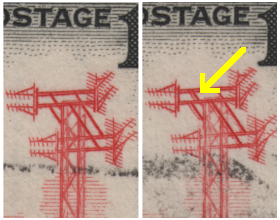 |
| Regular Issue | See: Definitive | |
| Reissue | See: Reprint | |
| Relief Printing | Relief Printing, also known as letterpress, typography, or surface printing, is a printing method in which the ink is transferred from the raised surface of the printing plate to paper. | |
| Reprint | Reprints are stamps printed from the original plates after the initial issue has been withdrawn from circulation. Reprints generally fall into two categories:
|  |
| Revenue | Revenue stamps, also known as fiscal stamps, are issued by governments to facilitate the payment of taxes, duties, or fees. These are typically affixed to documents, such as deeds, contracts, and licences, or to physical goods like tobacco or alcohol, as proof of payment. Many countries, particularly throughout the British Commonwealth, have issued stamps inscribed "Postage & Revenue," indicating they are valid for both postal and fiscal purposes. Generally, these stamps are worth significantly less when they bear a fiscal cancellation, such as a handwritten signature or a perfin punch, compared to those with a postal cancellation. Philatelists often use the terms "revenue" and "fiscal" interchangeably, though a subtle distinction is sometimes made, with "revenue" used to describe the stamp itself, while "fiscal" frequently refers to its use or cancellation. |  |
| Rotogravure | Rotogravure is a form of photogravure printing carried out on a rotary press using engraved cylinders rather than flat plates. It is designed for high-speed, high-volume production and is the method by which most photogravure stamps have been printed. | |
| Rouletted | Rouletted stamps feature a series of slits or cuts in the paper between the stamps to facilitate separation. Unlike perforation, which uses a punch to remove small circular chads of paper, rouletting involves only cutting or piercing the paper without removing any material. When separated, rouletted stamps typically have straight, slightly ragged edges rather than the uniform semicircular teeth of perforated stamps. |  |
| Royal Philatelic Society London (RPSL) | Founded in 1869, the Royal Philatelic Society London is the world's oldest philatelic society. Based in London, it serves as a global centre for philatelic research and expertise. The Society has published its official journal, The London Philatelist, continuously since January 1892. In addition to maintaining one of the world's most comprehensive philatelic libraries, the Society provides a wide array of services for its international membership, including operating The Spear Museum of Philatelic History and offering expert authentication services through its renowned Expert Committee. | |
| RPSL | See: Royal Philatelic Society London |
S
A . B . C . D . E . F . G . H . I . J . K . L . M . N . O . P . Q . R . T . U . V . W . X . Y . Z| Salvaged Mail | See: Crash Cover | |
| SCADTA consular overprints | SCADTA (Sociedad Colombo-Alemana de Transportes Aéreos), a private airline that operated in Colombia from 1919 to 1940, was the first successful commercial airline in the Americas. It was uniquely authorised by the Colombian government to issue its own airmail stamps to cover the costs of its private transport service. Because these stamps paid for the flight within Colombia, they were sold at Colombian consulates worldwide so that senders abroad could prepay the internal Colombian airmail fee before posting their letters. To identify the Consulate where the stamps were sold, the stamps were overprinted with abbreviations of the country of sale. Examples include A for Alemania (Germany), E for España (Spain), and Eu for Estados Unidos (United States). |  |
| Semi-postal, Semipostal | See: Charity Stamp | |
| Selvage | See: Selvedge | |
| Selvedge | Selvedge (also spelt selvage, particularly in North America) is the border or margin paper surrounding the stamps in a sheet or pane. Selvedge is an integral part of the sheet and can either be left plain or printed with various markings, such as: Plate numbers, cylinder numbers, traffic lights, marginal inscriptions, registration and alignment marks such as guide lines, or tabs that continue the stamp's theme | 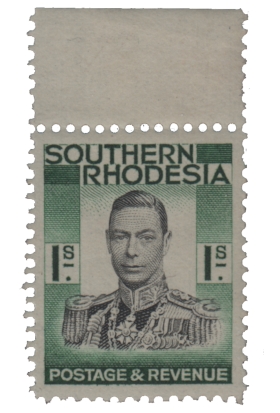 |
| Se-tenant | Se-tenant (French for 'joined together'): Two or more adjoining stamps that remain unseparated, yet differ from each other in design, colour, denomination, or overprint. Se-tenant stamps may be part of a composite design where the image continues across multiple stamps, such as a panoramic landscape, or feature distinct designs, such as a series of different birds or flowers. |  |
| Sheet Perforation | See: Harrow Perforation | |
| Silk thread paper | Silk thread security paper, also known as Dickinson paper, was patented by John Dickinson in 1829. Designed to prevent forgery, it contained embedded threads that made the paper difficult to replicate. Despite the common name, the threads were typically made of cotton, not silk. This paper was most notably used for: | 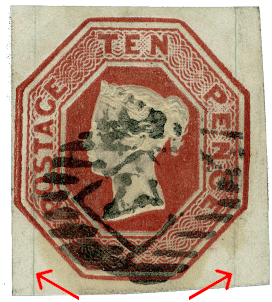 |
| Singly Fugitive Ink | See: Fugitive Ink | |
| Smiler, Smiler Sheet | Smilers, a brand name used by Britain’s Royal Mail for sheets of stamps featuring personalised labels attached to valid postage stamps, were first made available to the public at the International Stamp Show in May 2000, where special photo booths were set up for this purpose. To cater to collectors who did not wish to include a photograph, Royal Mail also released generic Smiler sheets featuring pre-printed labels with various themes. The first of these featured various "smiling" faces, which gave the format its name. Although subsequently, a wide range of themes have been featured, the "Smilers" title has been retained as a permanent brand. |  |
| Socked-on-the-nose (SON, SOTN) | Socked-on-the-nose, also known as a bullseye cancellation, refers to a circular date stamp that is struck perfectly in the centre of a stamp. A true "socked-on-the-nose" cancellation is clear and upright, showing the complete name of the post office, the date, and often the time of posting. |  |
| SON, SOTN | See: Socked-on-the-nose | |
| Souvenir sheet (SS) | See: Miniature sheet | |
| Specimen | Specimens of newly issued postage stamps are distributed to members of the Universal Postal Union to help them identify genuine issues. To prevent these specimens from being used for postage, they are marked with an overprint or perforated with a perfin. Although SPECIMEN is the most common marking, it often instead appears in the language of the issuing country, such as MUESTRA (Spanish), SAGGIO (Italian), or MONSTER (Dutch and Afrikaans). | 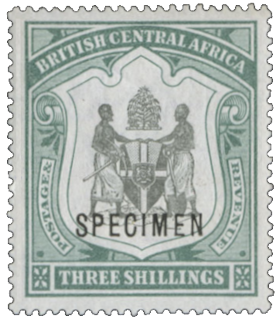 |
| Strubel Issues | The Strubels is a popular nickname for the Swiss definitive stamps issued between 1854 and 1862. The design features a seated figure of Helvetia wearing a laurel wreath, which is often mistaken for unkempt hair. This distinctive feature prompted German-speaking collectors to name the stamps "Strubels", after a well-known character from a popular German children’s book. Another notable feature of this issue is that it was printed on Dickinson silk thread paper, a security measure designed to prevent counterfeiting. |  |
| Subject | See: Cliché | |
| Substituted Cliché | See: Cliché | |
| Sulphurisation, Sulfurization (US) | Sulphurisation, sometimes mistakenly referred to as oxidation, is a chemical reaction that causes certain stamp inks to darken when they react with sulphur compounds in the air. This chemical reaction can often be reversed by briefly submerging the affected stamp in a dilute hydrogen peroxide solution. However, especially for valuable items, this treatment is best left to those with the necessary specialist knowledge. |  |
| Surcharge | See: Overprint | |
| Surface Printed Issues | Postage stamps of Great Britain, relief printed by Thomas De La Rue & Co. between 1855 and 1883, are known as the Surface Printed Issues. The term surface printing is synonymous with relief printing. | 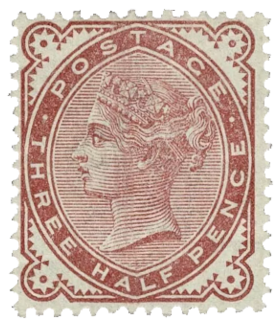 |
| Surface Printing | See: Relief Printing | |
| Sweatbox, Sweat box | A sweatbox, also known as a humidor, is used to remove stamps from paper or to separate stuck-together stamps without immersing them directly in water. It operates by creating a high-humidity environment that softens the gum or adhesive through moisture absorption rather than direct saturation. A typical sweatbox consists of a sealed container with a damp sponge at the bottom and a raised grille or mesh to support the stamps. This prevents the stamps from making direct contact with the water while allowing the humid air to penetrate the gum. While commercial versions like the "Stamplift" are popular, effective ones are easy to make at home. (Image courtesy brightonpete) |  |
T
A . B . C . D . E . F . G . H . I . J . K . L . M . N . O . P . Q . R . S . U . V . W . X . Y . Z| Tab | Tabs are the portion of the selvedge that remains attached to a stamp and features an illustration, inscription, or decorative element that complements the stamp's theme. While other selvedge is often discarded, many collectors consider a tab an essential part of the philatelic item. Tabs are a defining characteristic of the stamps of Israel, where nearly every issue since 1948 has been printed with descriptive tabs on the bottom row of the sheet. These tabs often add biblical or historical context for the stamp's design. | 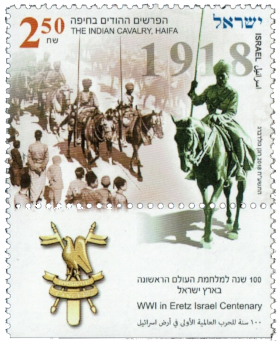 |
| Tagging | Tagging refers to the application of phosphor bands or other luminescent substances to postage stamps to enable their detection and processing by automatic mail-facing and mail-sorting machinery. The tagging is identified under ultraviolet light, typically shortwave for phosphorescent tagging and longwave for fluorescent tagging, allowing the machinery to determine the stamp’s position for cancellation and to assist in verifying the correct postage. In the United States and Canada, the term tagging is commonly used, whereas in British and Commonwealth philately, these markings are more often referred to as phosphor bands or phosphor bars. | 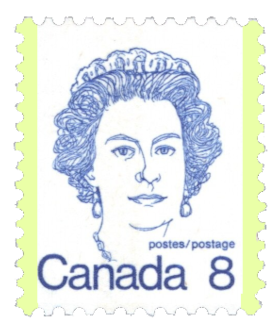 |
| T, Taxe Mark | A taxe mark is a postal marking, typically consisting of the letter "T" applied by handstamp or manuscript to a postal item to indicate that insufficient postage has been prepaid by the sender. On domestic mail, such markings were sometimes used instead of postage due labels to indicate the amount to be collected from the addressee before delivery could be completed. On international mail, the originating postal administration applied the “T” mark together with a numerical indication of the postage deficiency, expressed in UPU gold centimes (1/100th of a gold franc). This unit of currency was defined by the Universal Postal Union (UPU) to provide a standardised basis for calculating international postage due charges. In accordance with UPU regulations, the postal administration in the destination country converted the deficiency into its own currency to determine the amount payable by the addressee. The term derives from the French taxe, meaning "tax" or "duty". |  |
| Telegraph stamp | Telegraph stamps were stamp-like labels used to prepay telegraph fees. Typically affixed to telegraph forms, they were cancelled by the clerk as proof of payment. Telegraph systems were initially developed by private companies but were later nationalised in many countries. As a result, early telegraph stamps were issued by private enterprises, while later issues were produced by government postal and telegraph authorities. While these labels resemble postage stamps, they were legally valid only for the transmission of telegrams. Army and Military Telegraph stamps were specialised issues used to prepay telegraph fees for the military. These were often employed during active campaigns or at permanent military installations to help keep army communications and accounting separate from civilian postal and telegraph systems, and to ensure that operational traffic remained distinct. |  |
| Tête-bêche, Tete-beche | Tête-bêche (French for 'head-to-tail') is a pair of stamps in which one is inverted in relation to the other. |  |
| Thematic | A thematic or topical collection is organised according to a particular subject rather than by country of origin. Although the terms are often used interchangeably, topical collecting usually focuses on the stamps, whereas thematic collecting often takes a broader approach that may also include postal history, cancellations, and cachets to develop a narrative around the chosen subject. Popular collecting topics include, amongst others, transport (such as trains and planes) and fauna and flora (such as flowers, animals and fish). |  |
| Thirkell Position Finder | The Thirkell Position Finder is a transparent plastic grid, numbered 1-17 horizontally and A-T vertically. By placing it over a stamp, the grid coordinates can be used to draw attention to the precise locations of specific features of a stamp design or to any anomalies such as plate flaws. | 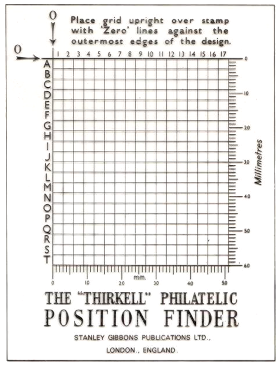 |
| Thomas De La Rue & Co | Thomas De La Rue & Co. is a well-known British printing company that produced playing cards, stamps and banknotes, amongst other things. | |
| TO PAY | See: Postage due label | |
| Tongs | See: Tweezers | |
| Topical | See: Thematic | |
| Traffic lights | Traffic lights, also known as check dots or colour dabs, are coloured markings often found in the margins of sheets of stamps. They serve as a visual aid for the printer to assess the accuracy of the printed colours during production. By examining these markings, printers can verify that the inks are being applied at the correct density and that the registration, the precise alignment of the different colours, is accurate. |  |
| Transfer Roller | A transfer roller is a small steel cylinder used to reproduce a design from a die onto a printing plate. The softened roller is pressed against the hardened die under great pressure, forcing the engraved design into the roller so that it appears in relief. The roller is then hardened and “rocked in” repeatedly onto a softened steel plate, impressing the design multiple times to form a complete sheet. This process produces consistent impressions of the original engraving, though minor variations can occur. | 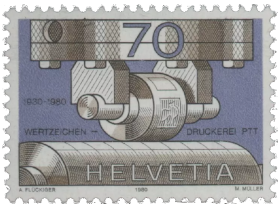 |
| Transient Variety | A transient variety, also known as a non-constant variety or coincidental variety, is a non-recurring or irregular deviation caused by a temporary occurrence during printing or production. Examples include ink smears, paper folds, or spots caused by dust on the printing surface. Unlike constant varieties, transient varieties do not consistently appear in the same position on successive sheets or printings. | |
| Transit Mark | Transit marks are postmarks applied by intermediary post offices that handle a mail item between its office of origin and its final destination. These markings are often applied as backstamps on the reverse of the cover or postal item. For postal historians and collectors, transit marks are invaluable for determining routes and travel times, and can sometimes help identify the specific ships, railway lines, or transport services used during transit. | |
| Triptych | A triptych is a set of three se-tenant stamps designed to form a single continuous image or design when joined together. Although each stamp is valid for postage individually, the full artistic effect is achieved only when the stamps remain attached as an unsevered strip or block. | 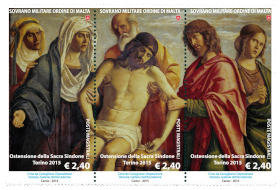 |
| Tweezers | Tweezers, also known as tongs, particularly in North America, are tools specifically designed to handle stamps without causing damage. |  |
| Typography | Typography generally refers to the art of arranging printers' type for maximum legibility and aesthetic appeal. Philatelists, however, also use the term typography as a synonym for relief printing. |
U
A . B . C . D . E . F . G . H . I . J . K . L . M . N . O . P . Q . R . S . T . V . W . X . Y . Z| Ultraviolet (UV) Light | Ultraviolet (UV) radiation, commonly known as UV light, is a form of electromagnetic radiation with wavelengths ranging from 100 to 400 nanometres (nm), which falls outside the visible spectrum. UV lamps are essential tools for detecting luminescence on stamps and postal stationery. For philatelic purposes, UV light is generally divided into two categories:
|  |
| Underprint | An underprint is a design or pattern, often in the form of burelage, printed on the face of a stamp prior to the application of the main design. It serves primarily as a security feature to deter counterfeiting. Underprints are sometimes mistakenly referred to as backprints. | 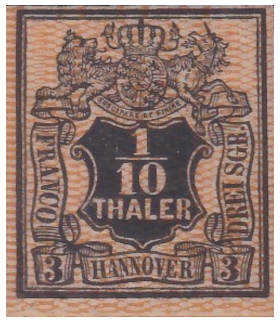 |
| Unexploded Booklet | See: Booklet | |
| Universal Postal Union (UPU) | The Universal Postal Union, founded in 1874 and now an agency of the United Nations, coordinates postal policies amongst its member countries, standardises international postage rates, defines mail classifications and markings, and coordinates the exchange of specimen stamps between postal administrations. |  |
| Unwatermarked | Unwatermarked refers to stamps printed on paper that does not include a watermark. While most classic and early 20th-century stamps used watermarked paper as a security measure, many modern issues are unwatermarked due to more advanced security printing techniques. | |
| UPU | See: Universal Postal Union | |
| UV | See: Ultraviolet Light |
V
A . B . C . D . E . F . G . H . I . J . K . L . M . N . O . P . Q . R . S . T . U . W . X . Y . Z| Value tablet | A value tablet is a designated area within a stamp design that displays the stamp's denomination. | 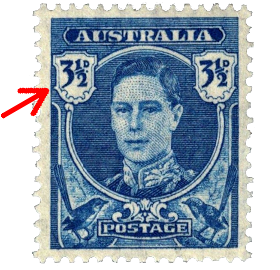 |
| Variable Value Stamps | See: Machine Label | |
| Variety | A variety is any stamp that differs in an identifiable way from the normal issue as originally intended. Differences may involve colour, perforation gauge, paper, watermark, overprint, errors, printing, or other production characteristics. Varieties may be either constant or transient, and may range from minor differences to major errors. A major variety differs substantially from the normal stamp and is commonly listed in both general and specialised catalogues. A minor variety shows only slight differences from the standard stamp and is often omitted from general catalogues, although it may be of interest to specialist collectors. | |
| Varnish bars | Varnish bars, also known as lacquer bars, were used primarily on Austrian stamps to deter the fraudulent reuse of cancelled stamps. The diagonal varnish lines applied to the face of the stamp made it difficult to remove the cancellation without damaging the stamp. | 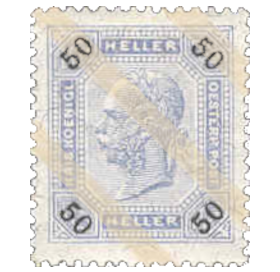 |
| Vignette | A vignette is the central part of a stamp design, such as a portrait, landscape, or heraldic symbol. It is often printed in a different colour from the surrounding frame, particularly in bicoloured issues. |  |
W
A . B . C . D . E . F . G . H . I . J . K . L . M . N . O . P . Q . R . S . T . U . V . X . Y . Z| Watermark | A watermark is a translucent design or pattern pressed into wet paper during the manufacturing process by a mechanical device, such as a dandy roll, to deter counterfeiting. Depending on the paper and watermark, the design may be visible when held against a light or a dark surface. However, in many cases, it may only be visible when the paper is immersed in a watermark fluid. |  |
| Watermark fluid | Watermark fluid, a highly volatile liquid that won't harm stamps or their gum, is used to reveal watermarks. To use, place a stamp face down in a small black plastic tray and apply a few drops of the fluid to the back of the stamp. This causes the paper to briefly become transparent, allowing the watermark to be seen against the dark background. While proprietary watermark fluids, such as Clarity or Safety, are made specifically for this purpose, many collectors use lighter fluids, such as Ronsonol, as effective and entirely satisfactory alternatives. |  |
| Wilding | Wilding refers to the British definitive series issued between 1952 and 1967. The stamps are named after the photographer Dorothy Wilding, who took the 1952 portrait of Queen Elizabeth II that appears on the design. This series is recognised for its use of different floral emblems representing the four nations of the United Kingdom and for having a wide variety of watermarks, graphite lines, and phosphor bands throughout its long period of use. The Wilding series was eventually replaced in 1967 by the Machin definitives. |  |
| Wing margin | Wing margins are the unusually wide margins found on certain stamps of Great Britain and some of its colonies, printed by Thomas De La Rue & Co before about 1880. These occurred only on stamps adjacent to the central gutter of a sheet. When the gutter was perforated down its centre, the stamps on either side retained a significantly wider unprinted margin than the other stamps in the pane. While their relative scarcity has made them attractive to many modern collectors, they were once considered undesirable. Early collectors often trimmed the wide margins with scissors to make the stamps appear more symmetrical or to fit neatly into pre-printed album pages. | 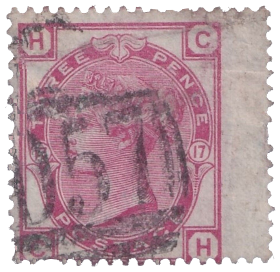 |
| Wrapper | A wrapper is a sheet of paper used to wrap a newspaper or periodical for mailing, often at a discounted printed-matter rate. Classified as postal stationery, wrappers may be imprinted with a stamp-like indicium, though some required a separate postage stamp to be affixed. |  |
| Wreck Mail | Wreck Mail refers to a specific category of salvaged mail recovered from a ship that has been wrecked, sunk, or grounded. Although similar in nature to a Crash Cover, the term “Wreck Mail” is reserved exclusively for maritime disasters. Due to the conditions involved, these items often show signs of seawater exposure, such as staining, fading, or the loss of adhesive stamps. As a result, postal authorities typically apply a cachet explaining the condition of the mail, and in severe cases, the item may be delivered inside an Ambulance Cover, a larger, official envelope used to protect its fragile contents. |
X
A . B . C . D . E . F . G . H . I . J . K . L . M . N . O . P . Q . R . S . T . U . V . W . Y . Z| No Entries |
Y
A . B . C . D . E . F . G . H . I . J . K . L . M . N . O . P . Q . R . S . T . U . V . W . X . Z| No Entries |
Z
A . B . C . D . E . F . G . H . I . J . K . L . M . N . O . P . Q . R . S . T . U . V . W . X . Y| Z Grill | See: Grill | |
| Zeppelin | Zeppelin philately focuses on collecting stamps and covers related to the German dirigibles of the early 20th century:
In 1933, a 50-cent stamp was issued for the Chicago World’s Fair Century of Progress exhibition. Depicting the Graf Zeppelin over the Atlantic, it is affectionately known by collectors as the "Baby Zep". | 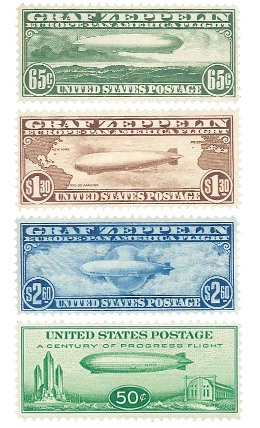 |
| ZIP Code | The ZIP Code is a postal code system introduced by the United States Postal Service in 1963. The name is an acronym for "Zone Improvement Plan", which was also intended to suggest that mail would "zip" more speedily through the system. The initial five-digit code was expanded in 1983 to a nine-digit format, known as the ZIP+4 code. |  |